


Seoul Smart City Prize Announces Winners for Its 2026 Edition
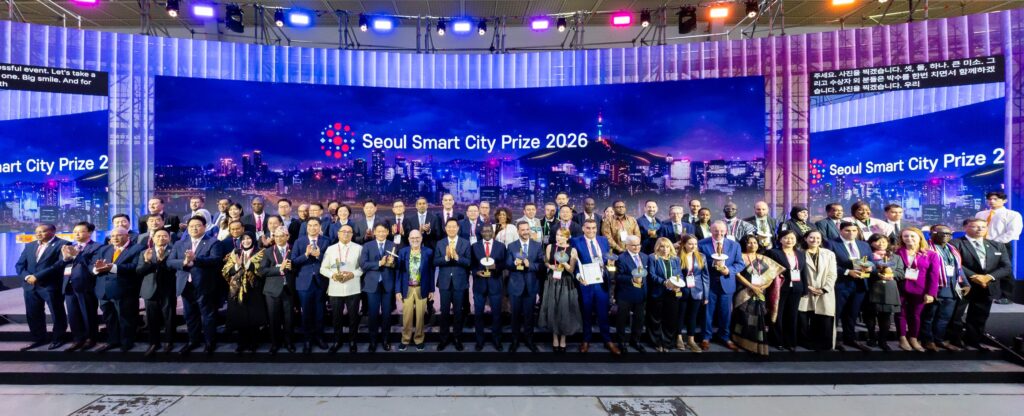
[Seoul, October 6, 2026] — The World Smart Sustainable Cities Organization (WeGO), in partnership with its President City, Seoul Metropolitan Government, hosted the Seoul Smart City Prize Ceremony in Seoul. Outstanding smart city initiatives dedicated to advancing human-centric and technological innovation were honored at the ceremony.
Drawing from 210 submissions from Africa, Asia, Europe, Latin America, Middle East, North America and Oceania, 46 semi-finalists were invited to join the Smart City Prize Ceremony, which took place during the Smart Life Week in COEX Convention & Exhibition Center in Seoul. WeGO recognized 21 winners across the Tech-InnovaCity, Human-CentriCity, Special Mention, and Leadership categories for driving exceptional smart city advancements. Leading the winners were Madrid and Quelimane, alongside the leadership of mayors representing Elliniko-Argyroupoli and Escobar. More information about the winners’ projects can be found on our official website.
These awards were presented by Seoul Smart City Prize High Council and Steering Committee Members, as well as Mayors.Prize Presenters included Maimunah Mohd Sharif, Former Mayor of Kuala Lumpur, Former UN-Habitat Executive Director; Vilas Dhar, President of Patrick J. McGovern Foundation; Karim Chelli, President of Canadian University of Dubai; Zhang Li, Dean of the School of Architecture, Tsinghua University, President, International Union of Architects; Danil Kerimi, Seoul Smart City Prize Steering Committee Chairman and member of the Independent Advisory Oversight Committee of World Intellectual Property Organization (WIPO); Jordi Vaquer, Secretary General of Metropolis; Alexandre Hedjazi, Senior Lecturer University of Geneva, Chair Geneva UNECE Center of Excellence Smart Sustainable Cities; M. Sanjayan, CEO of New York Climate Exchange (NYCE) and distinguished Mayors, including Oh Se-hoon, Mayor of Seoul; Yong-sun Park, Mayor of Pohang; Fred Jung, Mayor of Fullerton, Winner of 2025 Leadership Prize.
In the Tech-InnovaCity category, Madrid earned the Gold finalist honors with its “Madrid, Digital Capital” project which integrates AI and data to build a human-adaptive city ensuring inclusion. Since 2019, it eliminated paper administration, drove digital interactions to 83%, and deployed 30+ responsible AI use. The Silver finalists include Buenos Aires, where the ID Social empowers officials to instantly view comprehensive social trajectories through a single citizen profile accessible via Argentina’s national ID number, and Manila, which is enhancing disaster risk reduction and urban governance by consolidating hazard data into a unified geospatial system for precise barangay-level assessments.
Bronze recognitions went to Cuenca for turning solid waste into a circular economy platform; Konya for a zero-emission platform that replaces costly, polluting live-fire drills; and Granada for bridging the gap between AI development and real-world citizen benefits. Large institutions and corporations were also represented, including Pupil School Bus Ltd., which addresses safe student transportation by offering an IoT-enabled, air-conditioned carpooling service through a unified digital ecosystem, and Telúrica LLC, which is a real-time environmental risk intelligence platform that delivers decision-ready parcel reports for any property in Puerto Rico.
The Human-CentriCity category celebrated people-centered approaches to city life. Quelimane received the Gold prize with its Municipal Museum that transforms a vulnerable coastal city into a resilient hub by converting an underused public building into the region’s first Ethnobiological & Ethnological Exhibition, demonstrating climate resilience through cultural and behavioral change. Tokyo was recognized for its unified Generative AI platform across all 256 schools to transform teaching and learning while ensuring safety through strict data governance and ethical guidelines. Quezon City, from the Philippines, was selected as a Silver finalist for bridging the gap between waste policy and household reality by allowing residents to exchange segregated recyclables for Environmental Points redeemable for food, goods, and utilities.
Bronze acknowledgments went to the German city Karlsruhe’s program that embeds trained transformation agents to bridge the gap between one-off digital pilots and city-wide Smart City strategy; Las Rozas de Madrid for its dedicated accessible hub where older adults and people with disabilities learn to use digital services; and Taipei City for its comprehensive, student-centered support system which ensures equitable nutrition through digital redemption and traceability and personalized learning tools to bridge educational gaps. Institutional and corporation projects also stood out: The Comprehensive Association for Psychological and Social Crisis Therapy, the first free, fully Arabic MHPSS system in the Arab world, and the GoSense, from Lyon, France, which is empowering blind and visually impaired citizens to navigate complex urban environments safely.
The Leadership Prize this year celebrates two mayors who have demonstrated exceptional vision and commitment to urban innovation. Mayor Ioannis Konstantatos of Elliniko-Argyroupoli, in the Greater Athens Region, took the municipality from one of Greece’s lowest-rated in public services to 3rd nationally by 2025, leveraging Europe’s largest urban regeneration project and founding a 116-municipality resilience network. Meanwhile, under Mayor Ariel Sujarchuk, Escobar, in Argentina, became Argentina’s first municipality with comprehensive AI regulation, using tools like a WhatsApp assistant and AI-driven procurement to pioneer what Sujarchuk calls the shift from bureaucracy to “AI-cracy.”
The Prize also recognized projects of exceptional impact with Special Mentions. Special Mention partners included the SEMI Prize awarded by Semiconductor Equipment and Materials International (SEMI) to M-taka for transforming the invisible backbone of African cities with a mobile-first system that digitally connects informal waste workers with aggregators, recyclers, and municipal governments. Another Special Mention by New York Climate Exchange (NYCE) was awarded to Kaohsiung City for using CFD wind simulation, IoT sensors, and AI models to predict roadside tree failures before typhoons hit, preserving 87% of high-risk trees. Lastly, Special Mention by WeGO Smart City Index was in partnership with the Descartes Institute, along with the the United Nations Economic Commission for Europe (UNECE)-University of Geneva, Center of Excellence for Smart Sustainable Cities. This award was given to Los Angeles, recognized for transforming Los Angeles’ aging service system into a resilient, cloud-powered platform.
In 2026, the Prize maintained its commitment to honoring projects that pave the way for smarter, more inclusive cities globally. A diverse range of cities, organizations, and initiatives advancing human-centered digital transformation, inclusive innovation, and sustainable urban development were recognized for their impactful contribution to smart city development.
The winners of the Seoul Smart City Prize receive invitations to the Prize Ceremony & Smart Life Week (SLW) 2026 & 2027 with exhibition booths, tour programs, and B2B matchmaking, as well as an invitation to a training program for peer-to-peer learning and smart city site visits in Seoul. For selected winners, an opportunity to conduct pre-feasibility studies on a smart city project with financial support.
The 5th Edition of the Seoul Smart City Prize will open in January, 2027. Cities, corporations, institutions and leaders worldwide are welcome to apply.
About WeGO
The World Smart Sustainable Cities Organization (WeGO), is a membership-based international association of local governments, smart tech solution providers, and institutions committed to the transformation of cities into smart sustainable cities through facilitating public-private partnerships (PPP). WeGO was founded by 50 member cities in 2010 as the World e-Governments Organization, hence our acronym. In response to the evolving concept of smart cities, WeGO expanded its vision and mandate at the 4th General Assembly (2017) and its name to the World Smart Sustainable Cities Organization. WeGO’s Secretariat is based in Seoul, Korea, and has regional offices in East Asia (Chengdu, China), Africa (Abuja, Nigeria), Middle East & North Africa (Abu Dhabi, United Arab Emirates), Latin America (Cuenca, Ecuador), and Central Asia (Almaty, Kazakhstan). As the leading platform on smart city development, WeGO’s mission is to share knowledge and good practices in e-Governance; strengthen administrative efficiency and transparency; advance digital capacity; facilitate civic involvement; bridge the digital divide and inequality; and promote cooperation solidarity among cities and local governments around the world.
WeGO serves for its members as their international platform to improve the quality of life, innovate in the delivery of public services, and strengthen regional competitiveness.
Press Contact:
Name: Natália Penhalves
E-mail: natalia@we-gov.org
Phone: +82-70-4202-9169